


Flocabulary and RTI: Strategies for Successful Vocabulary Intervention
As a student teacher, I was paired with a lead teacher who was tasked with teaching a section of AIS (Academic Intervention Services) that combined two second grade classes reading well-below grade level. At a loss for how she could boost reading levels, she happened upon Flocabulary and The Word Up Project. From the minute I heard “The Space Rock” and saw the students rapping along with the song and moving their bodies, I knew I wanted to be a part of it. And when I implemented Flocabulary in my own classroom, it was a game changer.
Fast-forward to my role as the Coordinator at an all-girls urban high school in upstate New York. After reviewing my students’ test scores, I realized that they lacked vocabulary acquisition skills. I knew just what to do to assist my students in obtaining this skill: I reviewed each of the resources that Flocabulary provided and created a plan that worked for my students.
Below is a step-by-step guide of how I use Flocabulary in my RTI classroom to target vocabulary acquisition.[/vc_column_text][/vc_column][/vc_row][vc_row][vc_column][vc_text_separator title=”1. Introduce the New Words” title_align=”separator_align_left” color=”custom” border_width=”3″ accent_color=”#181828″][vc_empty_space][vc_column_text]I first introduce words to my students by providing them with the Fill in the Blank worksheet from one of the Word Up units. I play the selected video (one of their favorites is “Mandela is Free”) on the slow speed first and ask students to fill in the blanks as the song plays. Then, I replay the song at normal speed to give them an opportunity to fill in any blanks that they may have missed.
Once the song has been played twice, I project the interactive Fill in the Blank worksheet on the whiteboard. I read the song lyrics and the students tell me which word fits in the blank. Once they give me the word, myself or a student volunteer clicks on the blank and all students check that they’ve the word spelled correctly.

I then ask the students what the definition of that word is. The students use the song lyrics to provide me with the definition and then highlight that definition on the Fill in the Blank sheet. We continue until the all the blanks are filled in and we have discussed each of the words. At this point, students have a completed vocabulary anchor chart to assist them in future activities.[/vc_column_text][/vc_column][/vc_row][vc_row][vc_column][vc_text_separator title=”2. Create a Word Wall” title_align=”separator_align_left” color=”custom” border_width=”3″ accent_color=”#181828″][vc_empty_space][vc_column_text]During the next session, word exposure is done through creating flash cards for our world wall. While only one set of cards is used for the word wall, by having all students create cards they gain practice writing the word, writing the definition, and thinking about synonyms and antonyms.
I use the Frayer Model as the exemplar for students creating flash cards, and have the students use their Fill in the Blank anchor chart from the previous day as a reference. We use the first five minutes of each class to call out some of the words on our word wall. I’ll give the students the definition and they point to which word matches with the definition.
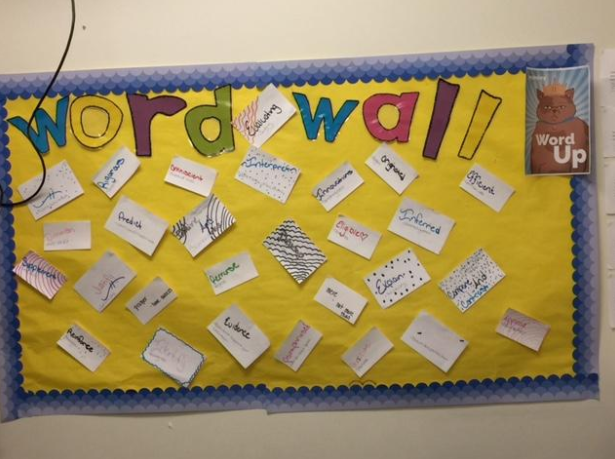
Jennie’s word wall of Flocab vocab words. How could this strategy work in your classroom?

When I introduce a new lesson, I include these words and continue include them in their flash card pack as well. To assess understanding on the spiral review words, I take questions from the previous lessons and add them to the activities of the current lesson. As students master words, they are removed from the student’s vocabulary card pack.[/vc_column_text][vc_empty_space][vc_column_text css_animation=”appear”] [/vc_column_text][/vc_column][/vc_row][vc_row][vc_column][vc_text_separator title=” 4. Impact” title_align=”separator_align_left” color=”custom” border_width=”3″ accent_color=”#182828″][vc_empty_space height=”20px”][vc_column_text]Flocabulary has made a huge impact on the way that I assist my students in obtaining the vocabulary that they need to be successful. As an RTI team, we measure student growth in percentile points. The students that we service have grown an average of five percentile points during the first semester of the school year.
