


8 Components of a Strong Balanced Literacy Program
As a former teacher, I should have known better than to assume the group knew what balanced literacy was. In the interest of saving time, I gave a quick response: “It’s what you do in your classrooms all of the time—word study, read aloud, reader’s workshop and writer’s workshop.”[/vc_column_text][/vc_column][/vc_row][vc_row][vc_column][vcex_heading text=”What Makes a Strong Balanced Literacy Program?” font_weight=”semibold” text_align=”left” font_size=”24px” color=”#181828″][vcex_spacing size=”20px”][vc_column_text]Unfamiliar with balanced literacy yourself? A strong balanced literacy program includes elements of whole language and phonics instruction. Here’s a quick overview of the different parts of a balanced literacy program:[/vc_column_text][/vc_column][/vc_row][vc_row][vc_column][vcex_heading text=”1. Shared Reading” font_weight=”semibold” text_align=”left” font_size=”22px” color=”#286fdc”][vc_column_text]Shared reading is an interactive reading process in which a teacher and student share in reading a text and the teacher models the skills of a proficient reader. When doing a shared reading, the text is available for both the student and teacher to see, whether it be looking at the same book or a projected reading on a screen.
As a teacher begins the shared reading process, he or she selects a skill or behavior they wish to model (for example, a teacher may model fluency). The teacher will read the text aloud fluently, with correct speed, accuracy, and intonation, and students will replicate the behavior. Shared readings support in-the-moment, replicable reading behaviors.[/vc_column_text][/vc_column][/vc_row][vc_row][vc_column][vcex_heading text=”2. Read Aloud” font_weight=”semibold” text_align=”left” font_size=”22px” color=”#286fdc”][vc_column_text]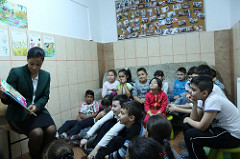 Read aloud is a process by which teachers select a text to model specific reading strategies often used by readers as they silently read. The process of reading aloud helps to support students’ listening comprehension skills as well as reinforce behaviors that readers would use if they are reading independently.
For example, a teacher may choose to read a text to model expression. They may choose to read a text to model self-to-text connections. They may even use a text instructionally for understanding main ideas, drawing conclusions, or identifying cause and effect. Read alouds are foundational for building many skills necessary to comprehend a text.[/vc_column_text][/vc_column][/vc_row][vc_row][vc_column][vcex_heading text=”3. Guided Reading” font_weight=”semibold” text_align=”left” font_size=”22px” color=”#286fdc”][vc_column_text]Guided reading allows teachers to create differentiated small groups to deliver reading instruction at a student’s particular reading level. While shared readings and read alouds are typically done for the entire class to model a particular reading behavior or reading comprehension skill, guided readings allow for targeted practice of a behavior or skill on level.[/vc_column_text][/vc_column][/vc_row][vc_row][vc_column][vcex_heading text=”4. Cloze Reading Procedure” font_weight=”semibold” text_align=”left” font_size=”22px” color=”#286fdc”][vc_column_text]Cloze reading is a strategy in which words are removed from a text to support a student’s reading comprehension. Teachers may choose to remove unknown vocabulary words in a passage in order to support a student’s ability to use context clues to determine the missing word. Cloze reading procedures engage students in a process of problem solving or analytical behaviors necessary when reading on level or difficult texts. [/vc_column_text][vc_empty_space height=”20px”][vc_cta h2=”Use Flocabulary to Support Your Literacy Strategies.” style=”custom” add_button=”right” btn_title=”Start My Free Trial ” btn_style=”custom” btn_custom_background=”#ecc000″ btn_custom_text=”#000000″ btn_i_icon_fontawesome=”fa fa-hand-pointer-o” css_animation=”appear” custom_background=”#2853a1″ custom_text=”#ffffff” btn_link=”url:https%3A%2F%2Fwww.flocabulary.com%2Fsubjects%2F%3Fsignup%3Dtrials||target:%20_blank|” btn_add_icon=”true” btn_custom_onclick=”true”]Sign up try Flocabulary free for up to 60 days.[/vc_cta][/vc_column][/vc_row][vc_row][vc_column][vcex_heading text=”5. Word Study / Vocabulary Instruction” font_weight=”semibold” text_align=”left” font_size=”22px” color=”#286fdc”][vc_column_text]Word Study in a balanced literacy program can involve decoding study of a word. For example, if studying the word “chain,” students would be working on both digraphs (“ch”) and vowel-vowel-consonant rimes (“ain”). Learning words phonetically in this way supports decoding and spelling abilities.
Word Study can also include studying meaning of a word—vocabulary. Using the above example, one could introduce the definition of the word “chain” as “a series of links.” The definition can also be paired with a picture to increase understanding.[/vc_column_text][vcex_spacing size=”20px”][vc_message icon_fontawesome=”fa fa-book” css_animation=”bottom-to-top”]We’ve compiled key research findings on how early differences in vocabulary size can have big implications for academic success down the read. Read the post now.[/vc_message][/vc_column][/vc_row][vc_row][vc_column][vcex_heading text=”6. Interactive Writing” font_weight=”semibold” text_align=”left” font_size=”22px” color=”#286fdc”][vc_column_text]Interactive Writing is a process by which teachers and students share the pen, essentially modeling parts of the writing process. Teachers may model writing a topic sentence for an introductory paragraph and students contribute what is included within the writing.[/vc_column_text][/vc_column][/vc_row][vc_row][vc_column][vcex_heading text=”7. Reader’s Workshop” font_weight=”semibold” text_align=”left” font_size=”22px” color=”#286fdc”][vc_column_text]Reader’s Workshop includes:
- a mini-lesson,
- independent reading time in which students are expected to practice a particular reading strategy taught during the lesson,
- teacher-student conferencing,
- small group instruction, and
- a close/share, in which students have an opportunity to model or express how they used the strategy during the workshop time.
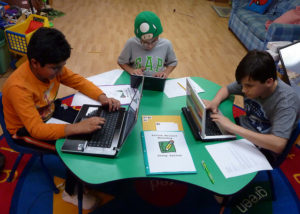 Similar to Reader’s Workshop, Writer’s Workshop includes a mini-lesson and independent writing time in which students are expected to practice a particular strategy during a phase of the writing process (generating ideas, drafting, revising, editing, and publishing).
Writer’s Workshop also includes teacher-student conferencing, small group instruction, and a close/share in which students have an opportunity to model or express how they used the strategy during the workshop time.[/vc_column_text][/vc_column][/vc_row][vc_row][vc_column][vcex_heading text=”Additional Reading” font_weight=”semibold” text_align=”left” font_size=”22px” color=”#286fdc”][vc_column_text]To learn more about balanced literacy, check out these resources:
“Balanced Literacy.” Reading A-Z. Lazel, Inc., n.d. Web.
Mermelstein, Leah. “The Components of Balanced Literacy.” What Does Balanced Literacy Actually Mean? Education.com, Inc., 19 July 2013.
Teach for America. Structuring Your Literacy Classroom: A Balanced Literacy Block (K to 5). N.p.: Teach for America, 2010. Elementary Literacy. Teach for America, 1 July 2010. Web.[/vc_column_text][vc_column_text]